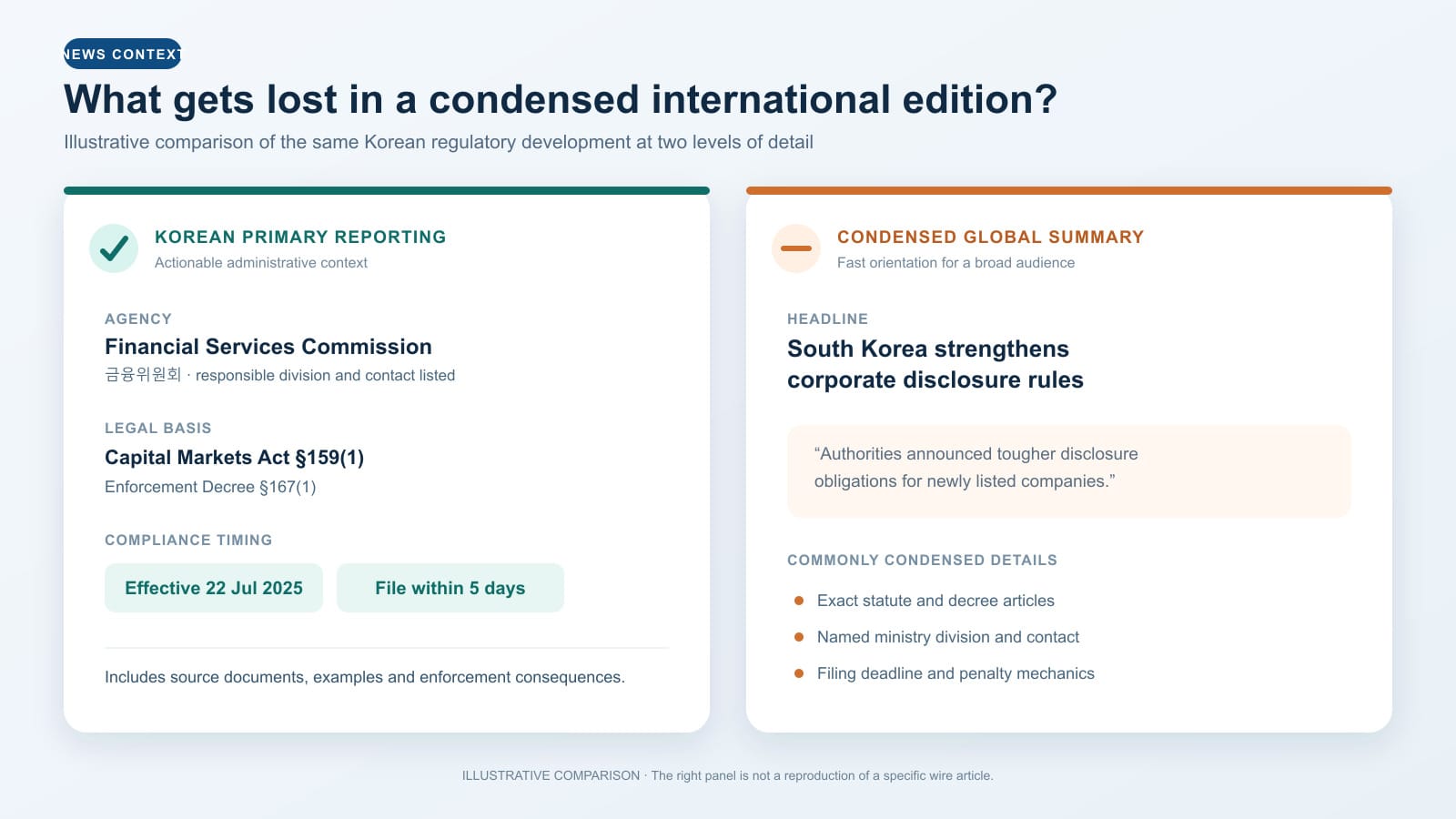
When major economic, corporate, or political developments unfold in Korea, global readers usually rely on English-language summaries published by international wire services like Reuters, Bloomberg, or the BBC. While these international editions excel at delivering quick global headlines, they frequently leave out the crucial context needed to understand the full situation.
If you read a brief three-paragraph summary of a Korean regulatory change or corporate scandal, you might learn what happened, but you will rarely understand why it happened or what will happen next. International editors systematically strip out specific legal clause numbers, domestic ministry titles, corporate governance structures, and local political background to keep articles concise for global readers.
This guide explains what information gets lost in international news translation, compares the depth of domestic Korean reporting against global wires, and shows you how to use AI translation tools to read raw Korean primary reporting directly.
What international editions leave out: Regulatory codes and ministry details
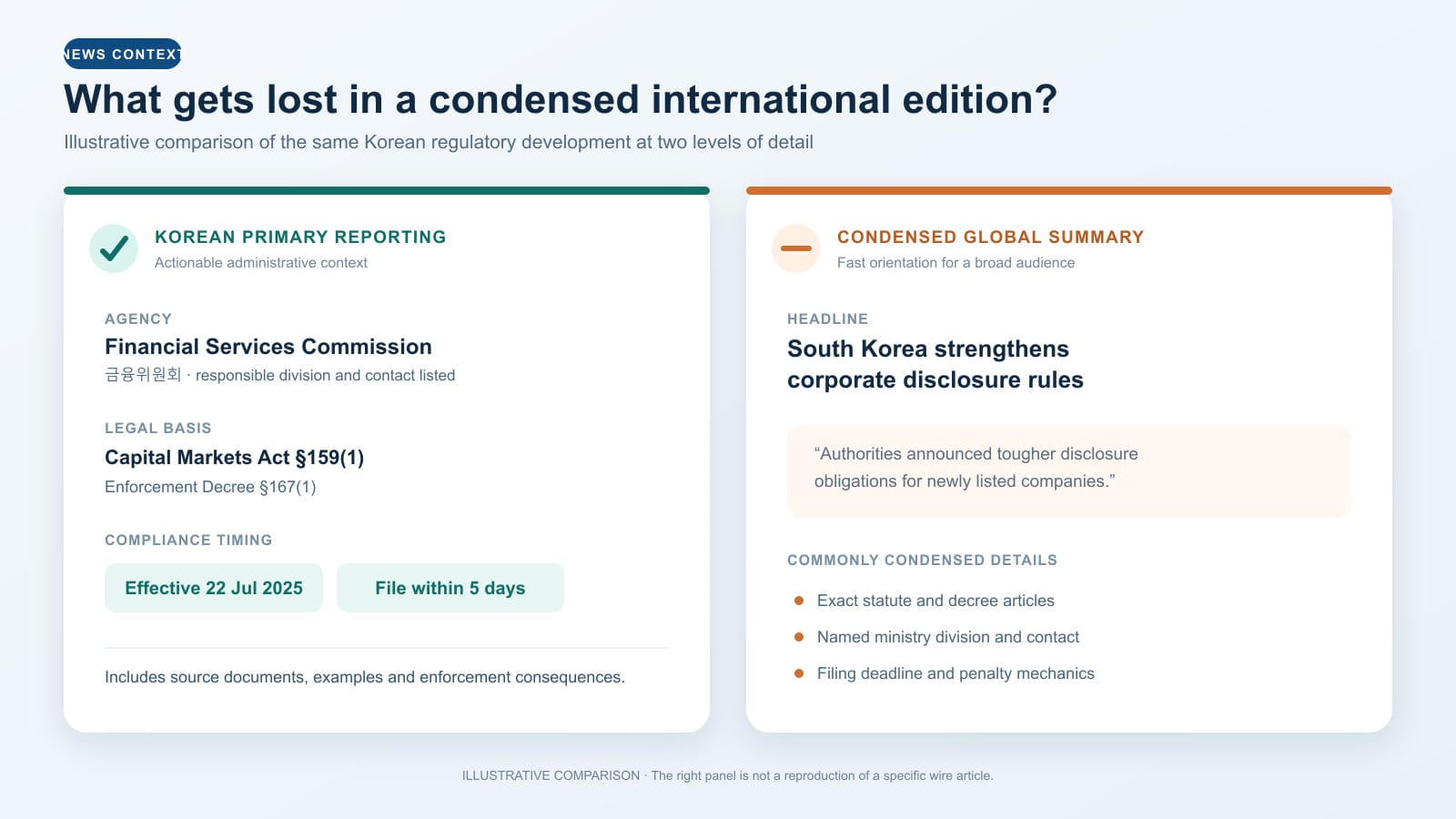
The most immediate difference between local Korean news and international coverage is the level of administrative and legal detail provided.
Omission of exact legal clauses
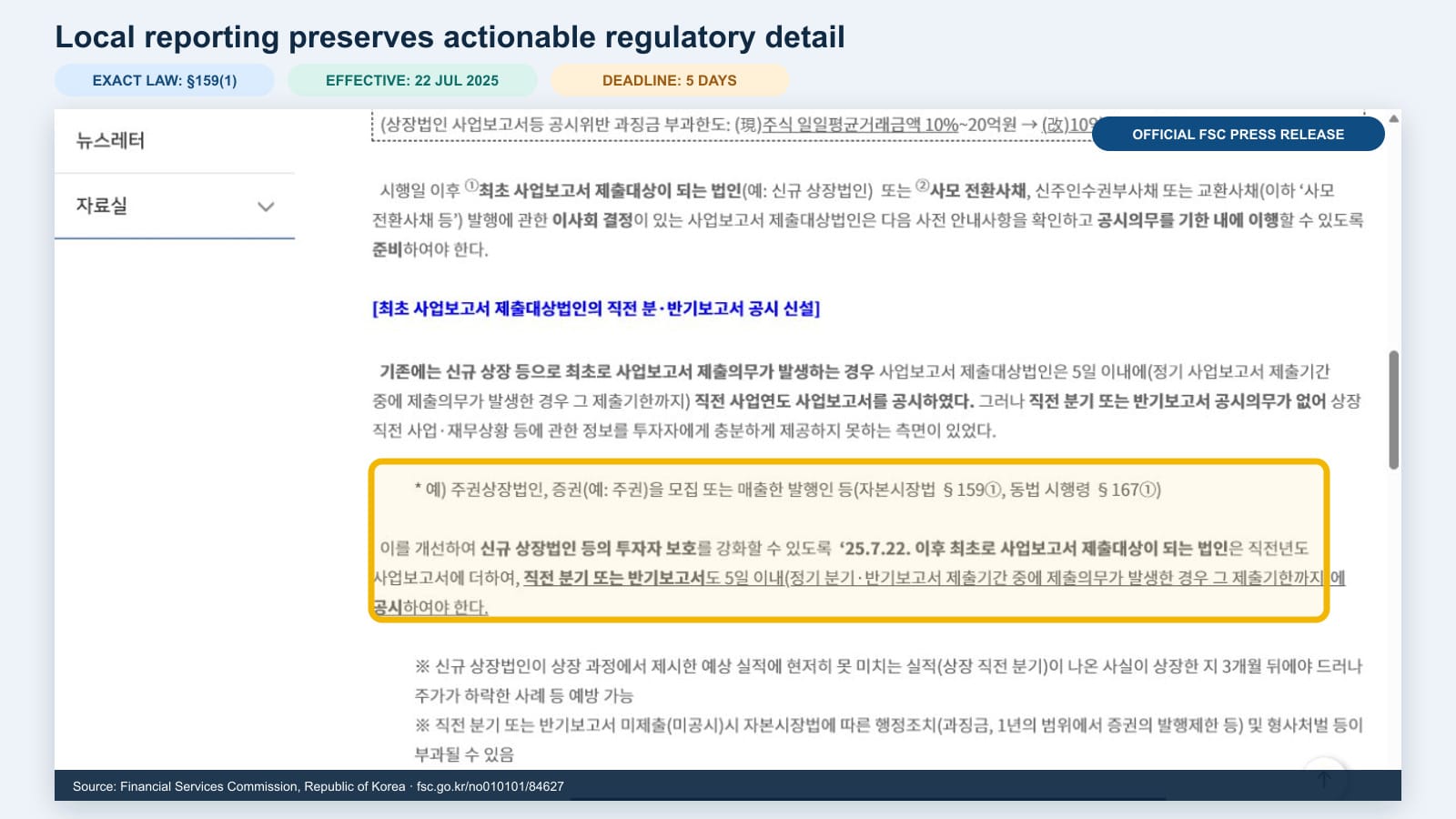
When Korea's Financial Services Commission (FSC - 금융위원회) or Fair Trade Commission (KFTC - 공정거래위원회) announces new market enforcement rules, domestic outlets on Naver News (네이버 뉴스) cite exact law numbers, specific article clauses, and precise compliance deadlines.
International wire services, by contrast, condense these complex regulatory shifts into vague generalities, such as "South Korea tightens financial oversight." For an investor or researcher needing to assess compliance risks, these omitted clause numbers represent the difference between actionable data and a useless headline.
Generic government placeholders
International editors frequently replace specific Korean government agency names with generic placeholders like "the government" or "South Korean authorities." This hides which specific ministry is driving the enforcement. Knowing whether an investigation is being spearheaded by the National Tax Service, the Fair Trade Commission, or local prosecutors provides crucial context about the severity of the enforcement.
Historical context and corporate nuances in Korean domestic reporting
Korean corporate governance and political decision-making are deeply intertwined with historical precedents that international editions rarely explain.
Understanding corporate shareholding and prosecution investigations
When covering major Korean conglomerates, known as Chaebols (재벌), domestic newspapers like Chosun, JoongAng, and HanKyoreh provide intricate breakdowns of family shareholding, circular ownership structures (순환출자), and prosecution charges (검찰 조사).
Foreign international editors almost always remove these complex ownership diagrams and prosecution details, summarizing a multi-faceted corporate restructuring battle into a simple "leadership dispute."
Local political rivalries that international editors cut
Domestic Korean journalists write for an audience that understands local political history. A domestic report on a controversial real estate or energy policy will connect current decisions to previous political scandals or regional rivalries. International editions strip out these historical references assuming global readers will not recognize them, making a logical domestic policy shift appear sudden or inexplicable.
Comparing depth: Naver News domestic reporting versus international wire editions
To illustrate the information gap between local primary reporting and condensed global summaries, consider this coverage comparison:
As shown in the table, relying exclusively on English international wire editions leaves significant blind spots for anyone needing precise data for legal or business decision-making in Korea.
How to use Papago and DeepL to read raw Korean news directly
You do not need to speak fluent Korean to access deep domestic reporting. Modern AI translation tools allow non-Korean speakers to bypass international filters and read primary sources directly on portal aggregators like Naver News.
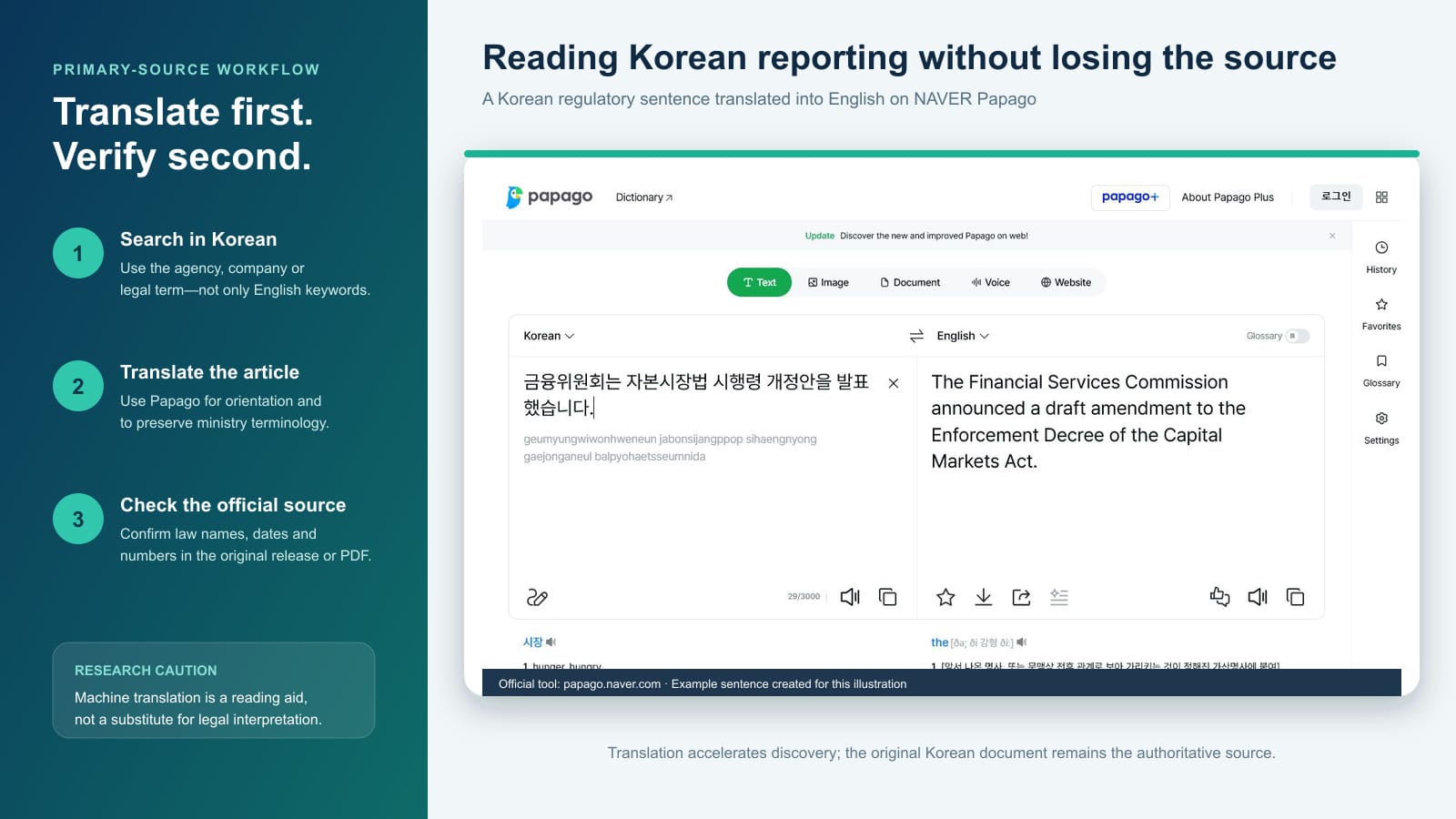
Step 1: Searching keywords on Naver News (네이버 뉴스)
Navigate to Naver News (news.naver.com). Instead of typing English keywords, use an AI translator to convert your target topic into Korean terms—such as specific ministry names (금융위원회), company names, or legal terms (공정위 조사). Paste these Korean keywords into the Naver News search bar.
Step 2: Translating full article bodies with Naver Papago or DeepL
Install the Naver Papago (파파고) or DeepL browser extension. Open a raw Korean news article (기사 본문) and click the translation extension button to translate the entire webpage into English or your native language. Modern neural AI translation models preserve technical legal terms and corporate titles with high accuracy.
Step 3: Cross-checking official press releases and government PDFs
Domestic Korean news articles frequently embed direct links to government press releases and downloadable PDF white papers (보도자료). By accessing these raw primary documents through translated local articles, you gain access to unedited data days before international media publishes simplified summaries.